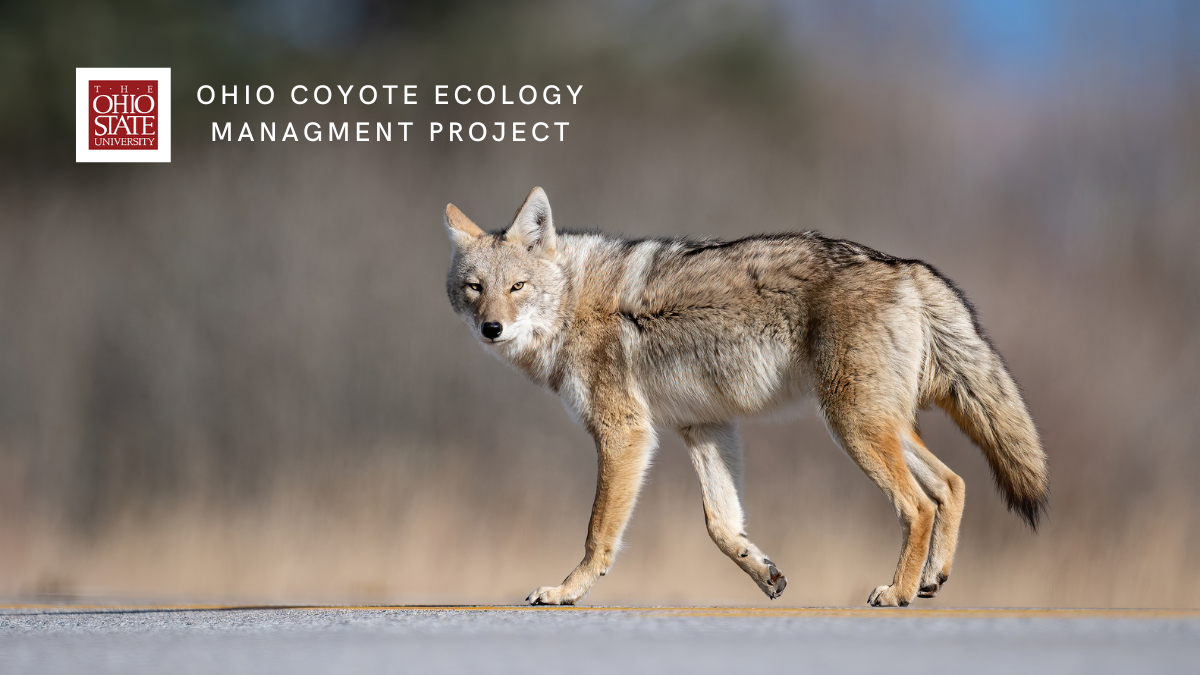
Ohio State is looking for livestock producers (sheep, goats, cattle) to participate with for the next phase of their project!
Ohio Coyote Ecology and Management Project:
Few animals elicit such strong, and opposing, emotions as the coyote. But love ‘em or hate ‘em, after decades of range expansion across the United States, coyotes are an established predator throughout Ohio. So, the question we can all agree on is: How do we minimize potential conflicts with coyotes in this state? And to answer that question, we need data.
Livestock production is a cultural and economic staple in Ohio, but it differs in many ways from production in the western US, where most of the coyote research has been done. Although Ohio produces more sheep and lambs than any other state east of the Mississippi River, the average flock size is 36 head, which means the loss of even a single animal exacts a disproportionate financial toll from local operators. Additionally, ecosystems in the Midwest are vastly different than those in the west. For any management strategy to effectively protect against coyote predation in Ohio, we need to know more about Ohio coyotes.
Some basic questions include: What do Ohio coyotes eat, and how does their diet change throughout the year? Do males and females eat the same things? Which coyotes are a bigger threat to livestock? How many coyotes are living in a given area? We can make educated guesses based on expert opinion and the research from other regions, but without local data it is speculation.
With support from the Ohio Division of Wildlife, our team at The Ohio State University has begun a multi-year study 1) to provide unbiased data on the extent to which coyotes consume livestock in Ohio, and 2) to identify strategies for managing the conflict. For this project to be successful, we aim to form partnerships among Ohio livestock producers. We want to provide a clear picture of the coyote-livestock situation and evaluate some management strategies that have shown promise in other regions of the US. We are collaborating with US Department of Agriculture/Wildlife Services and OSU Extension to reach out about this project and help us identify some potential partners.
The overall purpose of this project is to provide practical information to minimize livestock-coyote conflict in Ohio. If you are interested in contributing to the project, as a producer partner or with assistance collecting samples, please contact us for more information.
– Principal investigator: Dr. Stan Gehrt, Professor and Wildlife Extension Specialist
Interested? Contact the OSU Coyote Project at:
(614) 300-0754
Or
Dr. Brady Campbell at: